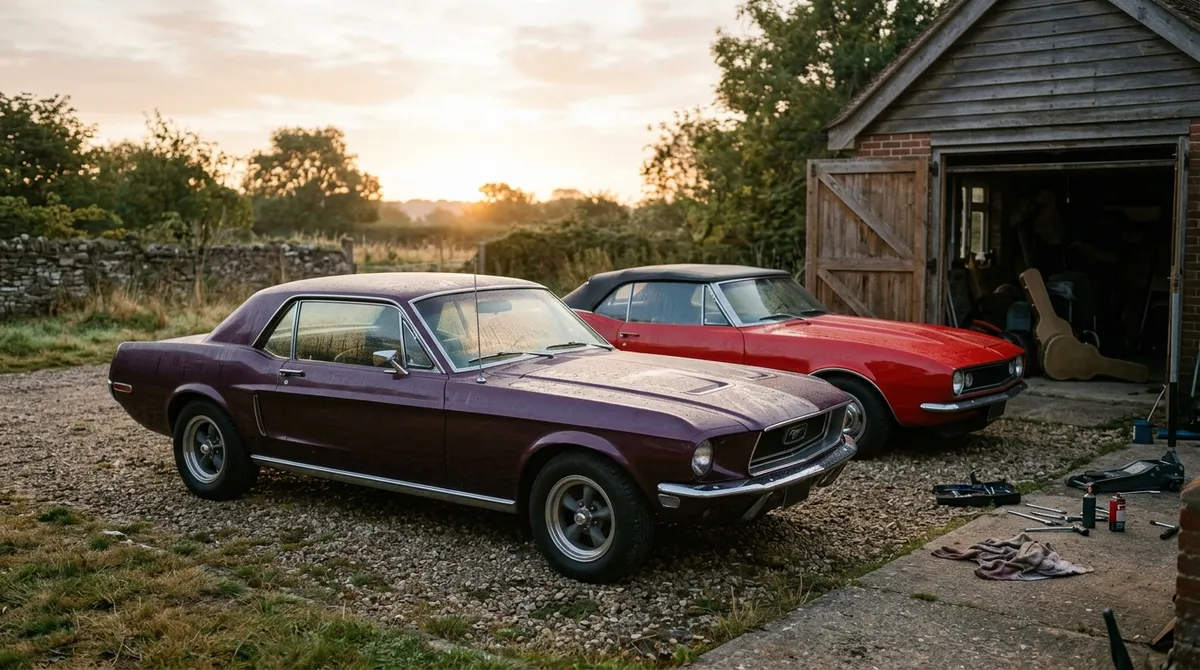
Grammy-winning musician Julian King owns two 1967 Pontiac Firebirds — a red convertible and a Plum Mist Ram Air 400 coupe — and most mornings he's out in the driveway before sunrise, garage doors open, wrenching quietly while the rest of Tennessee sleeps. Per reporting by Autoevolution, it's a ritual that connects music, family, and machinery in a way that's genuinely hard to manufacture.
That detail — two Firebirds, same year, different body styles — is worth sitting with. Because it points to something the collector car market has been slow to say out loud: the 1967 Pontiac Firebird is a smarter, more interesting buy than the Camaro it's always compared against, and most enthusiasts still haven't caught on.
The Camaro Gets the Glory, the Firebird Gets the Character
The 1967 Chevrolet Camaro launched as GM's answer to the Mustang, and it sucked all the oxygen out of the room. It still does. Camaro values dominate the auction headlines, Camaro restorations fill the magazine pages, and Camaro owners have approximately 4,000 clubs to choose from.
The Firebird launched the same year, on the same F-body platform, and has spent the five decades since living in that shadow. That's exactly why it's interesting.
Sharing a platform doesn't mean sharing an identity. Pontiac tuned the Firebird differently — the Ram Air 400 that King owns is a genuine performance variant, not a trim-level upgrade — and the styling reads as a distinct object, not a rebadge. The nose is longer and more aggressive. The character line along the body has its own logic. In person, a '67 Firebird doesn't look like a Camaro wearing a different badge. It looks like Pontiac had something to say.
Two Body Styles, One Model Year: Why That Matters
King's particular setup — a convertible and a coupe from the same model year — illustrates something collectors often undervalue: the 1967 Firebird offered genuine variety within a single year of production.
The coupe and the convertible aren't just the same car with a different roof. They carry different structural characteristics, different feel behind the wheel, and in the collector market, different trajectories. A Ram Air 400 coupe like King's is a documented performance variant; a convertible of the same vintage trades some of that mechanical drama for open-air experience and visual impact.
Owning both isn't redundancy. It's range. One for the track days and driver events. One for the Sunday morning cruise when the weather cooperates. The fact that they share parts compatibility is a practical bonus that any restorer will appreciate — you're not doubling your supplier relationships, you're deepening one.
The Pre-Dawn Wrenching Ritual
Autoevolution's profile of King lands on something that resonates well beyond his specific cars: the idea that the best part of owning a classic might not be the driving.
Watching the sun rise from your driveway, with the garage doors open and a project in front of you, is a specific kind of quiet that's hard to find elsewhere. It's not about productivity. It's not about finishing. It's the ritual itself — the early alarm, the coffee, the familiar smell of an old engine, the knowledge that whatever happens in the rest of the day, this hour was yours.
That framing matters for anyone considering a classic car purchase and wondering whether it's worth the complexity. The question isn't just "will it appreciate?" It's "what does it give me every week, regardless of value?" King's answer, apparently, is a reason to get up before the sun.
Why the Firebird Is Still Undervalued
Collector car markets move on perception before they move on logic. The Camaro's profile is so established that even ordinary examples carry strong premiums. The Firebird, despite its legitimate performance credentials and distinct design, still trades at a relative discount in most configurations.
That gap is the opportunity. A Ram Air 400 coupe or a first-generation convertible isn't an obscure barn find waiting for the market to discover it — these cars are known, documented, and desirable. But they haven't hit the ceiling that comparable Camaros have. For a buyer who values the driving experience over the bragging rights, that delta is meaningful.
The nostalgia wave driving classic car interest right now is broad enough to lift all boats eventually. Enthusiasts who've been priced out of obvious picks like first-gen Camaros and early Mustangs are actively looking for alternatives with real provenance. The '67 Firebird has that provenance. It just hasn't had its full cultural moment yet.
What to Look for If You're Shopping
If King's setup has you thinking about a first-generation Firebird, a few specifics worth knowing:
- 1967 is the first year of production, which carries its own collector significance. First-year cars often have minor differences from subsequent models that enthusiasts care about.
- The Ram Air 400 is a specific, documented option — not every '67 Firebird carries it. Verify the VIN and build sheet before any transaction.
- Convertibles require structural inspection beyond what you'd do on a coupe. Unibody flex on an old convertible can create problems that aren't immediately obvious.
- Parts availability for F-body cars is generally strong, but Pontiac-specific components (as opposed to shared GM parts) can require more searching.
The coupe versus convertible decision ultimately comes down to what you want the car for. Track use and performance events favor the coupe's rigidity. Visibility and experience on open roads favor the convertible. If you can do what Julian King did and find room for both — well, that's a different conversation to have with your garage.
The Actual Takeaway
The story of a Grammy winner wrenching on Pontiacs before dawn is a good story. But the more durable point is this: the 1967 Firebird is a legitimate first-generation pony car with genuine performance variants, distinctive styling, and collector values that haven't caught up to the Camaro yet. If you're looking for a classic that rewards daily engagement rather than just appreciation, it belongs on your shortlist — and you don't need two of them to find out why.