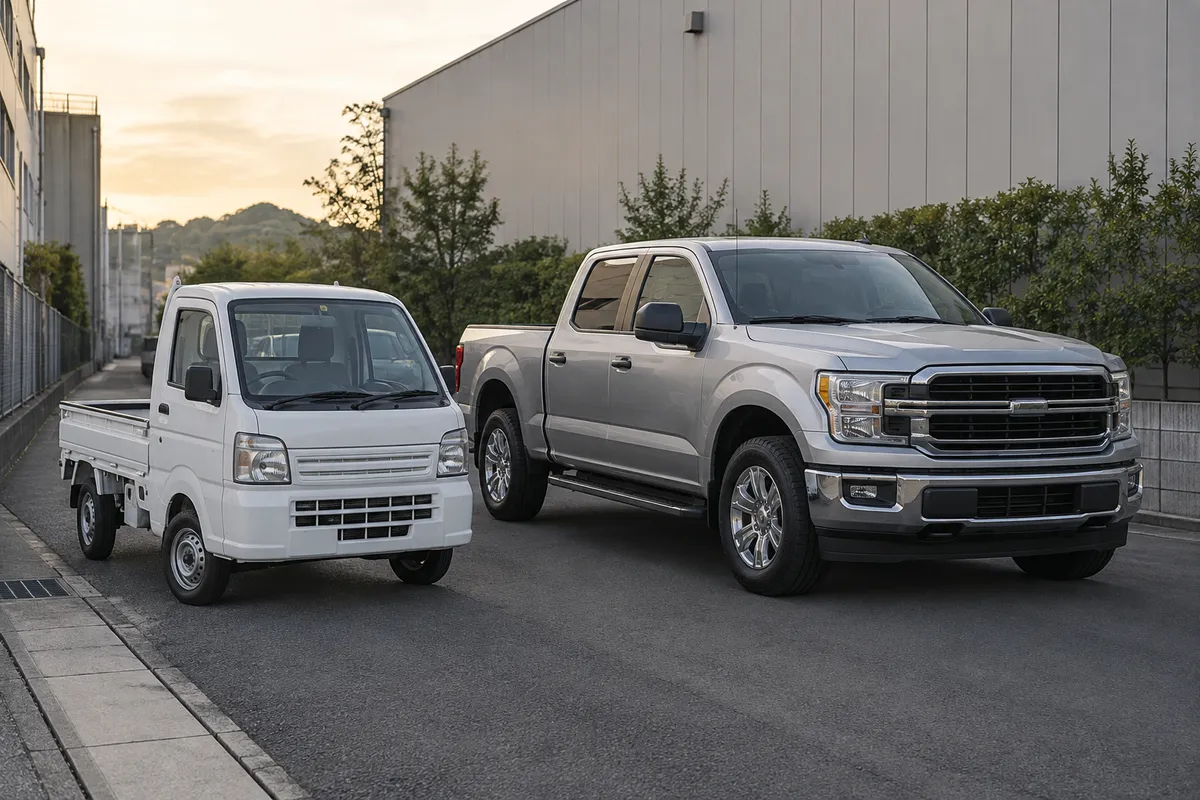
Japanese kei trucks keep showing up in memes aimed at America's oversized pickup culture, usually with a caption implying you could swap your F-150 for one and never notice. Slashgear took a hard look at that idea, and its conclusion is blunt: mini trucks excel at what they do, but they can't compete with full-size trucks on overall utility, passenger capacity, or highway cruising.
This piece gives you a practical way to decide which kind of truck fits your actual life, and why the meme misses the point.
The Core Problem With the Meme
Per Slashgear, kei trucks were engineered for a completely different market and a completely different set of jobs than American full-size pickups. That's the key to the whole comparison. A kei truck isn't a shrunken F-150 that fell short. It's a tool built around tight Japanese roads, small farms, and city work.
Judging it by full-size standards is like judging a cargo bike against a box truck. Both haul things. Neither replaces the other.
Where You Lose the Most: Utility and Payload
The biggest gap shows up when you load the bed or hook up a trailer. Slashgear's comparison covers payload capacity, power, and towing, and the direction is clear: full-size trucks carry more, pull more, and do it with far more power in reserve.
Here's how to apply that to your own situation:
- Write down your heaviest regular load. Mulch, lumber, a dirt bike, equipment? If it's occasional but heavy, a small truck will be working at its limit.
- Check your towing needs. If you tow a camper, boat, or equipment trailer, a kei truck isn't in the conversation.
- Think about frequency. Hauling a light load daily is a very different job from hauling a heavy one twice a year.
I'm not quoting specific payload or horsepower figures here because the numbers should come from the original comparison and from the spec sheet of any specific truck you're considering. The takeaway stands regardless: the gap is large, and it's structural.
Passengers and Cab Comfort
Passenger capacity is the second major loss. Full-size pickups are built to carry a crew and their gear. Kei trucks are compact work vehicles, and the cab reflects that. Slashgear's framing flags interior space and ergonomics as a real issue, especially for American drivers.
If you regularly carry more than one passenger, or you're a larger driver who wants room to stretch out on long days, sit in one before you commit. Cab dimensions that look charming in a video can feel very different after an hour behind the wheel.
Highway Cruising Is Not Their Job
This is where the comparison matters most for safety. Slashgear notes that kei trucks can't compete with full-size models for highway cruising. They were designed for lower-speed work, not for merging into fast traffic or holding speed alongside 18-wheelers.
If your commute or work route involves sustained highway driving, that alone may settle the question. Importing one also raises legal registration and safety concerns in the U.S., so check your state's rules before you buy rather than after.
Where Kei Trucks Genuinely Shine
None of this makes kei trucks bad. They do their intended job very well, and that's why enthusiasts like them. They suit:
- Farms and large properties, where speeds are low and maneuverability matters.
- Tight urban or rural lanes, where a full-size truck is awkward to park and turn.
- Light, repetitive hauling, where a big truck is more machine than the task needs.
If that's your life, a kei truck can be a smart, fun, characterful tool. It's an honest answer to a narrow question.
A Quick Way to Decide
Run through these three questions:
- Do you drive on highways regularly? If yes, lean full-size.
- Do you tow or carry heavy loads often? If yes, lean full-size.
- Is most of your use low-speed, light, and local? Then a kei truck deserves a look, assuming you can register and insure it legally where you live.
The cultural debate over truck size is real, and it's fair to ask whether many buyers need as much truck as they own. But that argument is about right-sizing, not about pretending one vehicle can do everything the other can.
The Takeaway
Before you click on another kei truck meme, match the truck to your heaviest, fastest, most frequent job. If a kei truck covers all three, enjoy it. If it fails even one, you've found your answer.